
This paper centres on a series of misdirections offered by Livy, specifically with regard to the greatness of Scipio Africanus and the qualities that enabled him to achieve his victory over Hannibal, but which left his later career stranded with no comparable successes.
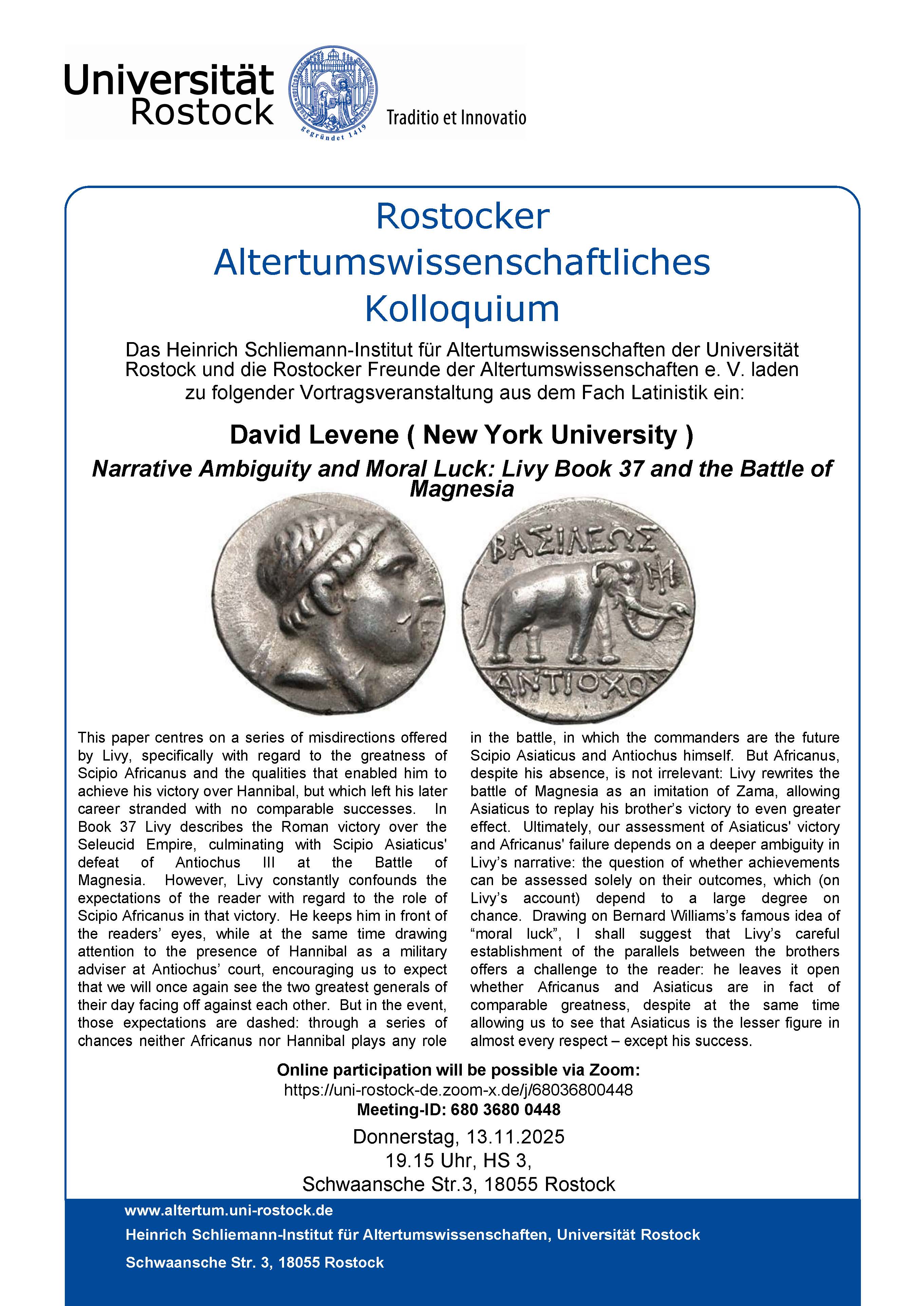
In Book 37 Livy describes the Roman victory over the Seleucid Empire, culminating with Scipio Asiaticus' defeat of Antiochus III at the Battle of Magnesia. However, Livy constantly confounds the expectations of the reader with regard to the role of Scipio Africanus in that victory. He keeps him in front of the readers’ eyes, while at the same time drawing attention to the presence of Hannibal as a military adviser at Antiochus’ court, encouraging us to expect that we will once again see the two greatest generals of their day facing off against each other. But in the event, those expectations are dashed: through a series of chances neither Africanus nor Hannibal plays any role in the battle, in which the commanders are the future Scipio Asiaticus and Antiochus himself. But Africanus, despite his absence, is not irrelevant: Livy rewrites the battle of Magnesia as an imitation of Zama, allowing Asiaticus to replay his brother’s victory to even greater effect. Ultimately, our assessment of Asiaticus' victory and Africanus' failure depends on a deeper ambiguity in Livy’s narrative: the question of whether achievements can be assessed solely on their outcomes, which (on Livy’s account) depend to a large degree on chance.
Drawing on Bernard Williams’s famous idea of “moral luck”, I shall suggest that Livy’s careful establishment of the parallels between the brothers offers a challenge to the reader: he leaves it open whether Africanus and Asiaticus are in fact of comparable greatness, despite at the same time allowing us to see that Asiaticus is the lesser figure in almost every respect – except his success.
Online participation will be possible via Zoom:
uni-rostock-de.zoom-x.de/j/68036800448
Meeting-ID: 680 3680 0448